



Land Seismic Data Processing
Land or Onshore seismic data can present a unique set of challenges. Surface conditions lead to static and noise issues, and geologically complex areas give rise to imaging problems. Geomage proprietary technologies help unravel these challenges with solutions proven across hundreds of 2D, 3D, and 4D projects worldwide.
Land Seismic Processing Challenges and Specifics
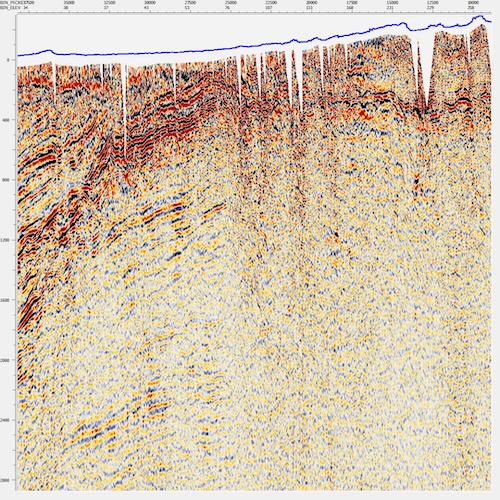
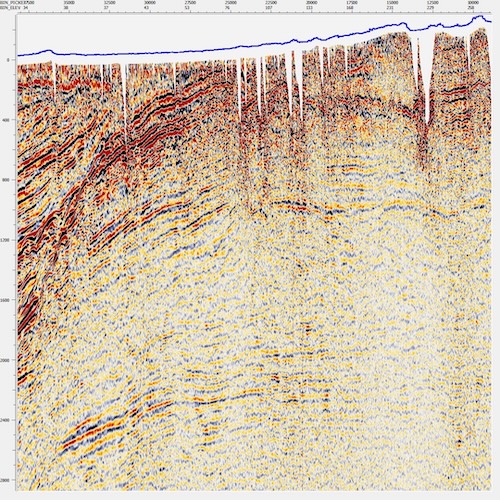
- Proprietary Refraction and Residual Surface-Consistent Statics provide a stable, high-resolution static solutions
- Tomographic or proprietary refraction statics give clarity to complex near-surface models
- Highly interactive velocity analysis with transparent stacking and gather response, enabling improved and faster decision-making
- Advanced approaches to noise attenuation and signal processing that preserves amplitudes while removing undesired wavefield components
- MultiFocusing Imaging™ (MF) improves spatial resolution and signal focusing before both Time and Depth migration
Complete 2D and 3D Land Data Processing Suite in g-Platform
Geomage delivers end-to-end land (onshore) seismic data processing using g-Platform™. The typical 2D and 3D land seismic workflow progresses from data loading and geometry assignment — supported by integrated QC tools — through spherical divergence correction, surface-consistent amplitude correction, noise attenuation, and surface-consistent deconvolution.
Refraction static corrections use both GLI and tomographic methods to resolve near-surface velocity variations, followed by iterative velocity analysis and residual static corrections for optimal stacking.
For 3D land data, additional steps include 5D interpolation and regularization to fill acquisition gaps, footprint attenuation to remove systematic amplitude patterns.
High-Resolution Radon-based demultiple is followed by anisotropic pre-stack time migration (APSTM) to ensure accurate structural positioning and imaging accuracy. Both workflows conclude with AVO attribute extraction, angle stacks, and pre-stack depth migration (PSDM) where subsurface complexity demands it.
Geomage's processing team handles the full range of land acquisition challenges: rough topography, frost zones, sparse 3D with low fold, wide-azimuth (WAZ) surveys, 3D merges, and 4D time-lapse processing for reservoir monitoring.
Ready to improve your land seismic results?
Contact our processing team or download g-Platform to run your own workflows.