



Marine Seismic Data Processing
Marine or Offshore seismic data typically present a distinct set of characteristic challenges, including various types of multiples, source and receiver ghost effects, parasitic air-gun bubble oscillations, deblending of simultaneous sources, swell noise, and other acquisition-related (technogenic) noise, as well as accurate imaging beneath complex geological structures such as salt bodies. Geomage combines advanced marine (offshore) seismic data processing technologies with proprietary MultiFocusing™ Imaging to deliver cleaner, higher-resolution seismic images.
Marine Seismic Processing Challenges and Specifics
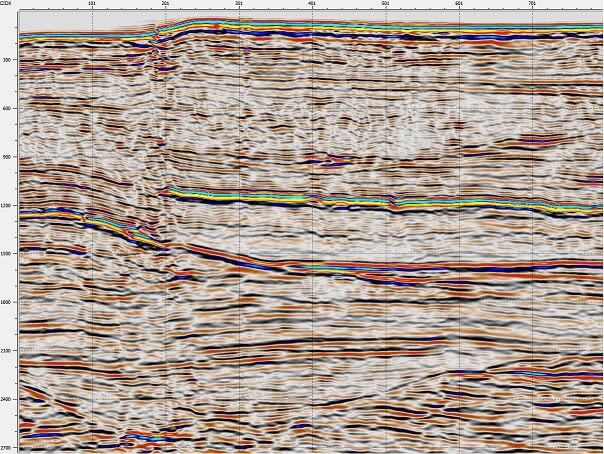
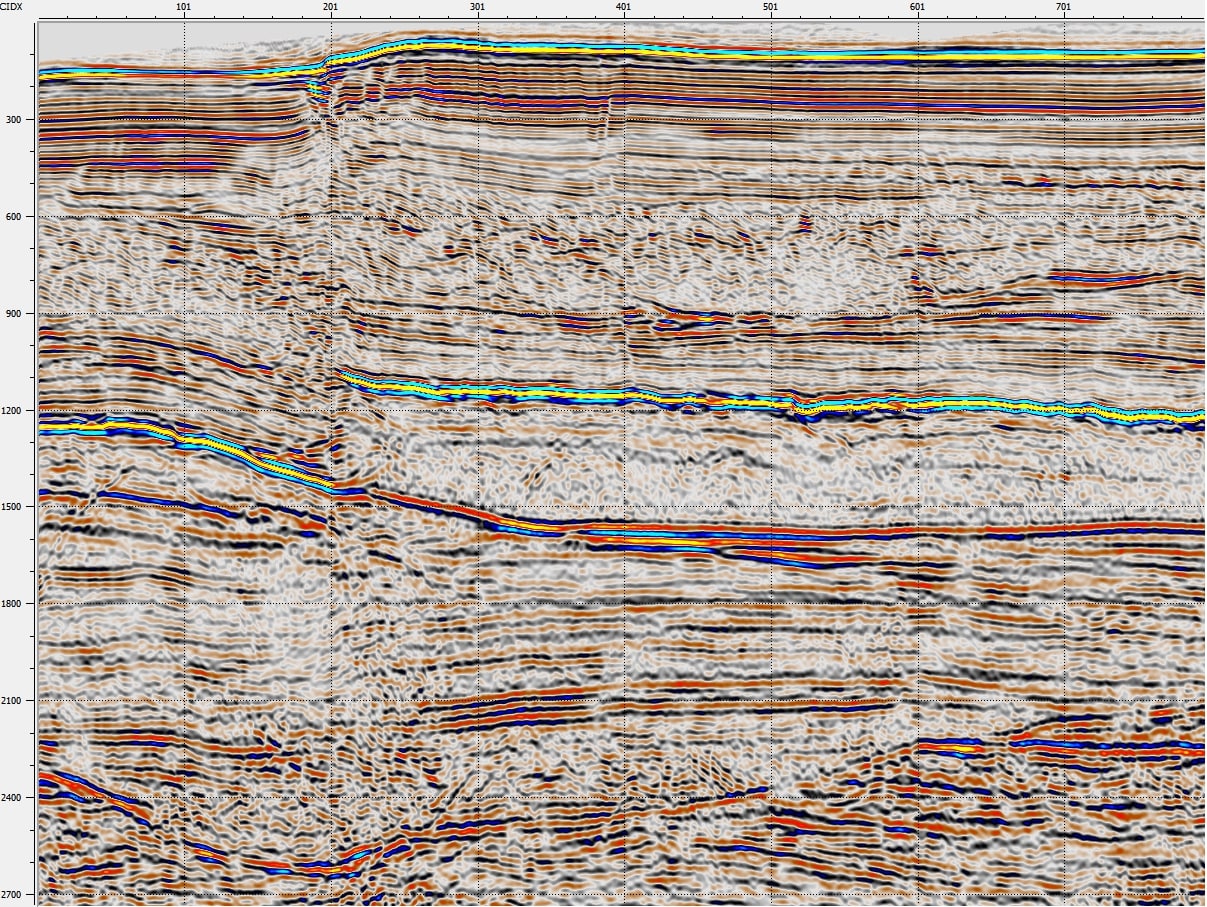
- Robust Tau-P Deghosting for consistent broadband marine data
- Powerful High-Resolution Radon demultiple and advanced Surface Related Multiple Elimination (SRME) with reliable, non-invasive adaptive subtraction
- MultiFocusing multiple analysis across wavefront parameters for clear primary/multiple separation
- Data-driven velocity information that identifies geologic boundaries in complex structure or salt
- Technology-derived velocity model building for enhanced Time and Depth Imaging
Comprehensive Marine Seismic Data Processing Suite in g-Platform
The Geomage marine seismic data processing sequence in g-Platform™ covers the entire workflow — from data loading and geometry assignment — supported by integrated QC tools — through final depth migration.
Early-stage processing typically includes essential conditioning steps such as low-frequency filtering, spherical divergence correction, direct wave and coherent noise attenuation, and swell noise removal — critical steps for cleaning offshore marine seismic data before amplitude-sensitive processing.
Debubbling, Deghosting, Designature, Zero-Phase correction prepare the wavelet for further broadband processing. Surface-Related Multiple Elimination (SRME) provides a data-driven first pass at multiple removal, while iterative High-Resolution Radon demultiple and adaptive subtraction refine the result. Velocity analysis feeds into anisotropic pre-stack time migration (APSTM), with higher-order residual moveout correction and residual time-phase correction ensuring gather flatness.
Final deliverables include optimized stacks, post-stack spectral balancing, AVO attributes with angle stacks, and pre-stack depth migration (PSDM) for projects requiring accurate depth positioning beneath complex overburden or salt.
Ready to improve your marine seismic results?
Contact our processing team or download g-Platform to run your own workflows.