



Fault and Fracture Detection
Geomage offers a proprietary direct method to detect and characterize fractures and other small-scale reservoir heterogeneities. The MFDI method is based on a moveout time correction that adequately describes diffraction events, enabling optimal summation of diffracted events and attenuation of specular reflections.
MultiFocusing Diffraction Imaging™ (MFDI)
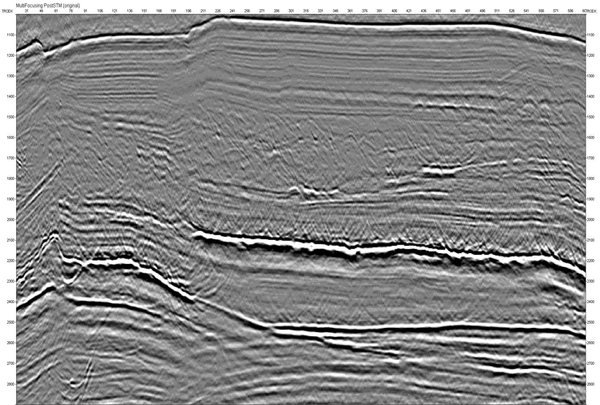
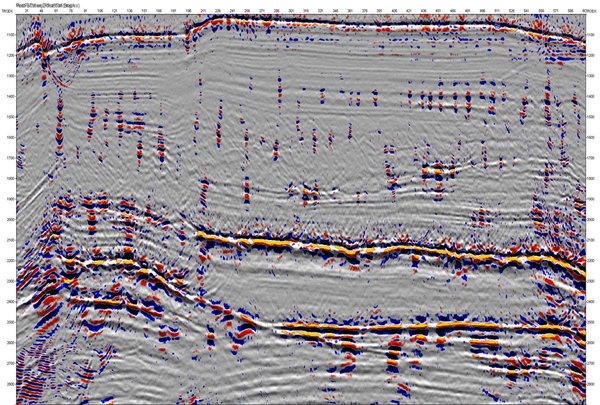
- Contour faults and salt bodies
- Locate naturally fractured reservoirs
- Avoid possible unwanted fluid pathways
- Map sources of velocity anisotropy
- Optimize horizontal drilling and well placement
How Diffraction Imaging™ (DI) works
Diffraction Imaging addresses the detection of small-scale geological objects such as faults, pinchouts, fractures, and karsts that pose challenges in hydrocarbon exploration. These subsurface features generate scattered or diffracted energy that conventional seismic processing typically obscures or eliminates during stacking, because diffracted wave amplitudes are substantially weaker than specular reflections.
The MFDI method uses MultiFocusing moveout corrections applicable to both reflection and diffraction events. By recognizing that when the radius of curvature of the wavefront equals the radius of curvature of the reflecting surface, we can focus diffraction energy while de-focusing reflection energy. The result is a full-azimuth seismic image containing primarily optimally stacked diffraction events.
Integration with petrophysical data provides calibration specific to a prospect area. The diffraction cube reveals local heterogeneities and discontinuities in the subsurface, providing information that helps optimize horizontal drilling, guide correct placement of exploration wells, and characterize fracture networks for reservoir development.
Interested in fracture detection for your project?
Contact our team for a diffraction imaging feasibility study or download g-Platform.